


Your Guide to Rollforming & Folding Innovation
What we’re seeing on the ground: Service wins
There’s lots of media talk on both sides of the Tasman about a slowdown in the manufacturing sector, and in broad terms that no doubt has some truth to it. Tariff talk isn’t slowing and the repercussions are certainly making many nervous, particularly regarding capital equipment upgrades. Interest rates have started to ease, but maybe not as quickly as some expected. Global trade uncertainty and the rollercoaster ride of the NZD and AUD against key currencies are all having impacts and taking their toll.
Broadly speaking, however, the numerous people I’ve recently spoken to fall into two camps:
A number of (predominantly bigger) operators had certainly noticed a pullback and more competition for smaller trade volumes. However, on the flip side, numerous other operators—those I personally see as having a high focus on quality and customer service, or a differentiated product offering—are in fact very busy. A few indicated they were experiencing record months, and the early signs were that August was going to be no different.
I met with one manufacturer recently who won several big contracts from an industry incumbent. How? They listened to their customer’s frustration about equipment damage from daily operations and made a simple design modification to their product. Not only did it eliminate those damage costs, but it actually increased the customer’s capacity. Once implemented, the customer couldn’t imagine going back. That’s the kind of thinking that’s winning right now.
With more options available, your customers are choosing suppliers who offer high-quality, accurate, or clearly differentiated products in a timely and agreed fashion—sometimes even if it costs more. In short, service is key and that’s what appears to be making all the difference.
Within that landscape, we’re also seeing an increased focus on maintenance planning and activity. Those dull blades leaving “a bit of a burr” are now a priority fix because nobody wants to give their customers an excuse to go elsewhere.
Critical spares mapping is also becoming a focus for businesses that want to minimise unplanned production downtime from not having parts available.
As a service-first business, this is obviously a trend we can get behind and it has led us to add our 5th service technician to the TRF family. Welcome Zach!
Whether you’re looking to differentiate your offering or minimise downtime, I’d love to discuss how we can help. Book a call with me here.
Purlin Watch: The wait is over!

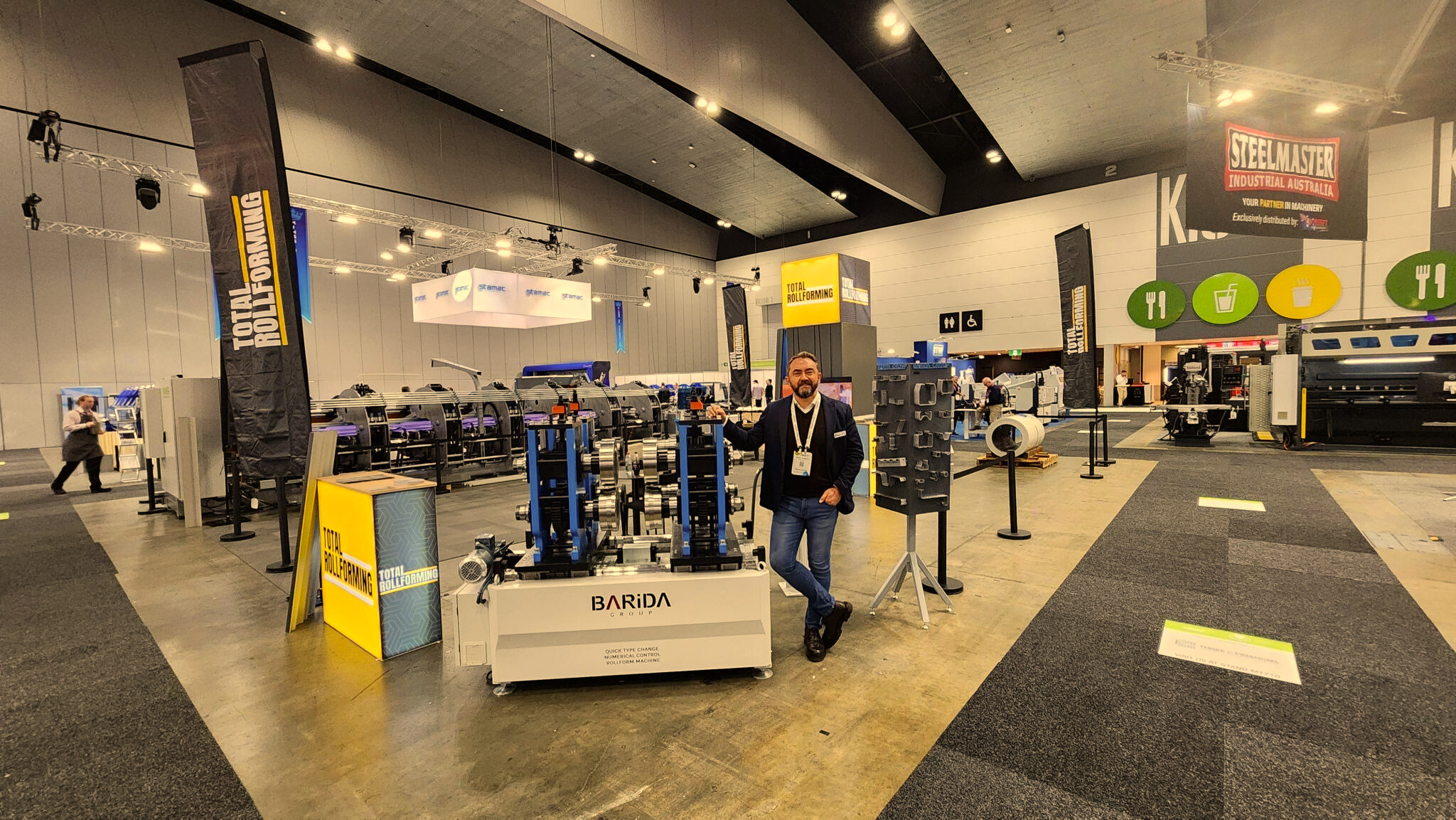
The first of our variable purlin mills has finally arrived from our production partner Barida Makina in Turkey! All nine 40ft containers were unloaded in record time and the line is starting to come together, led by technicians from Barida who have travelled to New Zealand for installation, commissioning, and operator and maintenance training.Despite a few frustrating shipping delays when the vessel was rerouted to another port at the last minute, we’re now full steam ahead. Once installed, the line—which includes assisted coil loading, 8 dynamic punches, automatic size change, and a 15m automatic stacking and bundling unit—will more than 5 x the production throughput for our customer, with significantly reduced manual handling.More to come next month.
MFB from CIDAN – small, mobile, versatile
This month’s product spotlight is on the MFB 1250mm portable folder from CIDAN Machinery, which attracted a lot of attention at AMW as people got a chance to see just how versatile and easy to operate it is.
With a bending capacity of 1.5mm mild steel (2.25mm aluminium), segmented top and bottom tooling, and available radius tools of R1.0, R2.0 and R3.0, it’s a powerhouse machine that would be a useful asset to any sheetmetal or flashing production shop.
Watch the video below to see it in action.
Maintenance Tip – Don’t let chain wear cost you downtime
The majority of rollformers are driven by sprocket and chain, an effective method of driving a number of interrelated tooling stages in a controlled fashion.
The extensive loads created by rolling flat coil into different rollformed products gradually stretch these very chains that we rely on to keep the line running.
What happens with chain stretch:
- Creates weakness in the drive system
- Can lead to chains breaking
- Worse still—chain stretch can cause shaft breakage
- Results in unnecessary and expensive downtime
Make sure you check for chain wear regularly to keep your line running smoothly.
Want to dig deeper into anything from this edition?
Reach out at solutions@totalrollforming.com or give us a call.
The future of sheetmetal fabrication is here—are you ready to embrace it?